NOTICE
Begin with what is there
Spend time with a place, a person, or a system before deciding what it needs. Woodhaven and the wider Okanagan are not scenery here; they give the question conditions, history, and scale.
SEE THE PLACE ↗
Method / how the studio works
At the UBCO MDes, the work is not a fixed recipe. It is a cycle of noticing, framing, making, testing, and returning to the people and places involved.
If you are considering the MDes, this is the clearest way to understand what you might actually do here.
SEE THE FOUR MOVES ↓The method is a way of working, not a promise that every project follows the same order. These four moves describe the rhythm that keeps the work connected to reality.
NOTICE
Spend time with a place, a person, or a system before deciding what it needs. Woodhaven and the wider Okanagan are not scenery here; they give the question conditions, history, and scale.
SEE THE PLACE ↗FRAME
Move from a broad concern to a question that can be investigated. Listen to different perspectives, name what is still unclear, and resist the urge to make the answer bigger than the evidence.
SEE THE PLACES ↗MAKE
Use conversation, drawing, code, materials, and prototypes to make a possibility tangible. A thing you can show gives other people something specific to respond to.
SEE WHAT THE YEAR INCLUDES ↗TEST
Put the work in front of people who were not in the room. Feedback, disagreement, and lived experience reveal what the first version could not see.
MEET THE PEOPLE ↗02 / IN PRACTICE
The work becomes visible in the route, the schedule, the tools, and the conversations. These are not portfolio decorations; they are the evidence that a question was tested in a real setting.
The 360 route shows how a place enters the brief.
OPEN THE WALK ↗ SCHEDULEName the systemsThe atlas connects campus, field sites, civic spaces, and partners.
OPEN THE ATLAS ↗ MAKINGWork with materialsStudio and shop time turn ideas into things that can be tested.
READ THE STUDIO GUIDE ↗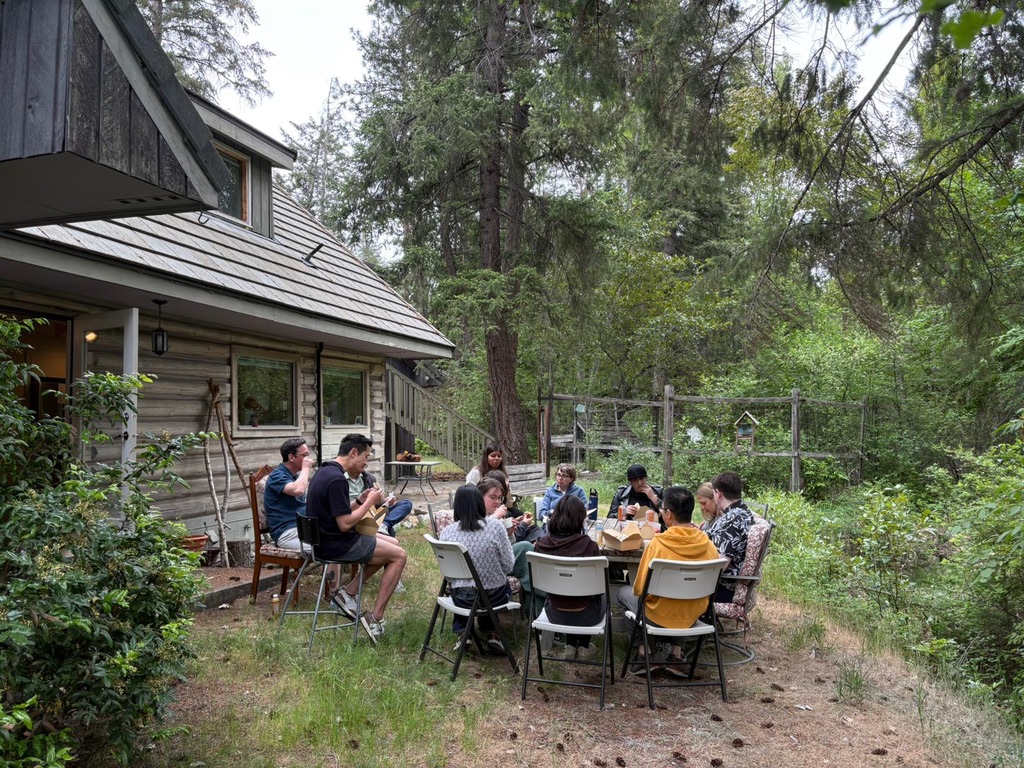
What the program brings together
The MDes is jointly grounded in Engineering and Creative and Critical Studies. Its four program cornerstones describe the range of expertise you can work across.
Critical design thinking, human-centred design, drawing, and visualisation help make a complex situation clearer.
Engineering principles, technology, making, and advanced manufacturing connect ideas to material and technical reality.
Innovation is treated as more than efficiency: it includes the ethical, social, and ecological consequences of what gets designed.
Social innovation, project management, communication, and venture thinking help develop possibilities with practicing partners.
How the work moves
The MDes is learning by doing: investigate a real situation, work with the people involved, make something tangible, test it, and use what you learn to change the next version. UBCO describes this movement as problem exploration and stakeholder engagement leading toward implementation, prototyping, and advanced solution development.
Investigate what is happening before deciding what to make. Look across disciplines, systems, and lived experience.
Listen to stakeholders, partners, and communities. Their knowledge changes the brief and keeps the work situated.
Use drawing, visualisation, code, materials, and conversation to give an idea a form that others can respond to.
Learn from feedback, return to the question, and develop the strongest direction far enough to communicate and implement.
Walk the field site, open the places from the schedule, or read the full program guide. Each route shows a different part of how the MDes works.